
Guides
What Is a Serviced Office? The Complete 2026 Guide
A serviced office bundles your workspace, infrastructure, and support staff into one monthly fee — no fit-out costs, no long leases, no facilities headaches. Here's everything you need to know before you sign.
By Arthur Truong
22 April 2026
(Updated 22 April 2026)12 min read
What is a serviced office?
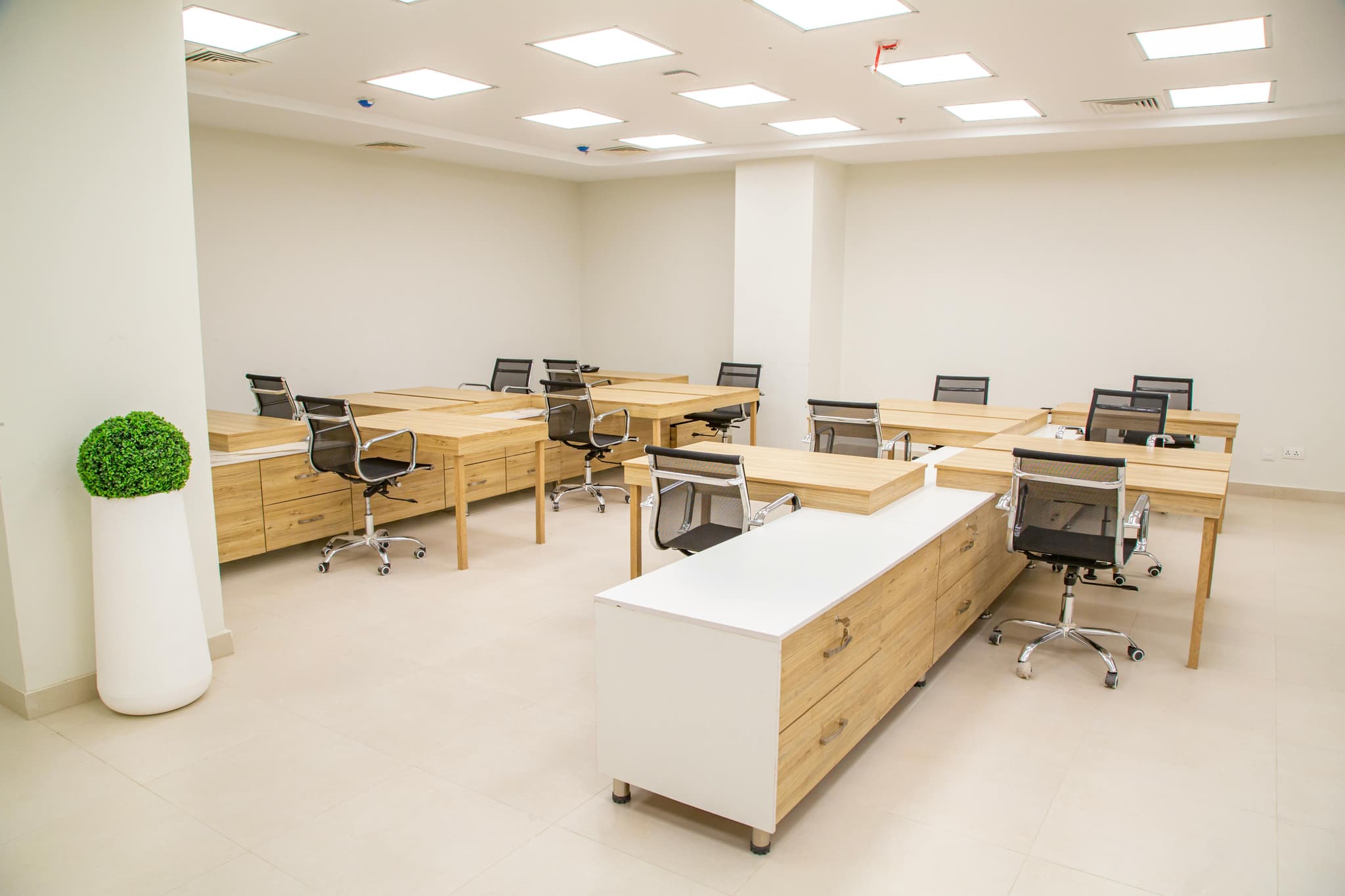
A serviced office is a fully managed, ready-to-use workspace that you rent on flexible terms — typically month-to-month or rolling short-term contracts — from a building operator who handles everything from reception staff and internet connections to cleaning, utilities, and maintenance. Unlike a traditional commercial lease, where a tenant takes an empty shell and funds its own fit-out, a serviced office is plug-and-play. You pay one inclusive monthly fee, move in within days, and get to work immediately. When your team grows or shrinks, you adjust your space rather than renegotiating a five-year lease. The term "serviced office" is sometimes used interchangeably with managed office or executive suite, though there are subtle distinctions — mainly in the degree of customisation and the prestige positioning of the building. In everyday use, all three describe the same fundamental model.
Quick definition
A serviced office is a private, lockable workspace rented on flexible terms, fully fitted-out and managed by the building operator. One monthly bill covers everything: space, infrastructure, and services.
Browse serviced office in Australia
Browse serviced office in Australia
How serviced offices work
The model is straightforward. A building operator — companies like Regus, WOTSO, or CBRE Workplace Solutions — leases an entire floor or building from a landlord. They fit it out with private offices, meeting rooms, and shared amenities, then sub-let individual offices to tenants on short-term licences rather than traditional leases. From the occupant's perspective, the process looks like this:- Enquire and tour — a workspace consultant shows you available office configurations (typically measured in desks, not square metres) and tailors a quote.
- Sign a licence agreement — most serviced offices use a licence rather than a lease, which means fewer legal formalities and a faster exit if your needs change.
- Move in — fit-out is already done. Furniture, cabling, Wi-Fi, and access passes are ready before you arrive.
- Pay monthly — one consolidated invoice covers your office, services, and most amenities.
- Scale as needed — when you hire, you take the adjacent office; when you downsize, you hand it back with minimal notice.
Industry insight
According to JLL's Asia-Pacific Flexible Space Report, flexible workspace (including serviced offices) now accounts for approximately 6–8% of total office stock in Australia's major CBDs, up from under 3% in 2019. The shift accelerated post-pandemic as companies reduced long-term real-estate commitments.
What's included in the monthly fee
This is where serviced offices genuinely earn their price premium over traditional leases. The all-inclusive fee typically covers the following, though you should confirm exactly what's bundled with each provider before signing:- Private, lockable office space — furnished with desks, chairs, and storage
- High-speed internet — usually fibre, with dedicated bandwidth options available
- Electricity, gas, and water — all utilities are the operator's responsibility
- Reception services — a staffed front desk to greet your clients and handle mail
- Cleaning and maintenance — daily or weekly cleaning, building upkeep covered
- Meeting room access — a set number of hours per month, typically 4–10 hours
- Kitchen and breakout areas — shared amenities such as coffee machines, fridges, and lounge zones
- Building security — 24/7 access, CCTV, and secure entry
- IT support — basic helpdesk assistance for connectivity and hardware issues
- Business address — a prestigious CBD address for your mail and company registration
What's usually not included
It's equally important to understand what falls outside the standard package. Common extras include: additional meeting room hours beyond your monthly allowance, dedicated phone lines and handsets, parking bays, printing beyond a base page allowance, and premium add-ons such as private lounge access or after-hours call handling. Always request an itemised breakdown of inclusions and ask specifically about meeting room credits — this is where many occupants find surprise charges at month-end.Serviced office vs the alternatives
Understanding where a serviced office sits relative to your other options is critical to choosing the right solution. The four main workspace types for businesses are traditional leases, serviced offices, coworking spaces, and virtual offices.| Feature | Traditional lease | Serviced office | Coworking | Virtual office |
|---|---|---|---|---|
| Private space | ✓ Yes | ✓ Yes | ✗ Shared | ✗ No |
| Fit-out required | Yes — tenant's cost | No — ready to use | No | No |
| Minimum term | 3–5 years | 1–12 months | Daily–monthly | Monthly |
| Upfront cost | High (fit-out + bond) | Low (1–2 months deposit) | Very low | Minimal |
| Scalability | Difficult | Easy | Very easy | N/A |
| Brand customisation | Full | Limited (signage, branding) | Minimal | None |
| Services included | None | Full bundle | Partial | Address only |
| Suitable for | Stable teams, 50+ | 5–50 people, growth stage | Freelancers, small teams | Remote businesses |
"The real value of a serviced office isn't the furniture — it's the optionality. When market conditions shift, you can right-size your footprint without a balance-sheet write-down. That's worth paying a per-desk premium for, particularly for businesses in growth or contraction cycles."
Sarah Ohlsson, Director of Occupier Services, Australia — cited in Property Council of Australia Flexible Workspace Roundtable, 2025
How much does a serviced office cost in Australia?
Pricing varies significantly by city, building quality, and team size. The per-desk rate typically decreases as team size grows — operators reward larger commitments with lower per-head rates. According to OfficeFlexFinder's Q1 2026 listings data, here's what businesses are paying across Australia's major markets:| City | 1–2 desks / mo | 6–10 desks / mo | 20+ desks / mo |
|---|---|---|---|
| Sydney CBD | A$1,200–1,800 | A$1,000–1,400 | A$800–1,100 |
| Melbourne CBD | A$1,100–1,600 | A$900–1,250 | A$750–1,000 |
| Brisbane CBD | A$900–1,300 | A$800–1,050 | A$650–850 |
| Perth CBD | A$800–1,200 | A$750–980 | A$600–800 |
| Adelaide CBD | A$700–1,000 | A$650–850 | A$550–720 |
| Singapore CBD | A$900–1,500 | A$800–1,200 | A$650–950 |
All figures are all-inclusive per-desk/month estimates based on OfficeFlexFinder listing data, Q1 2026. Rates vary by floor level, building grade (A vs B), and lease term length. Get a tailored quote →
What drives the price up?
Premium buildings in Grade A towers (think Governor Phillip Tower in Sydney or 101 Collins Street in Melbourne) will sit at the upper end of these ranges. Factors that push costs higher include: harbour or city views, a prestigious postcode (Barangaroo commands a 15–25% premium over the Sydney average), above-standard fit-out quality, and high meeting-room inclusions.What drives the price down?
Longer commitment terms, larger team sizes, and locations slightly outside the primary CBD (such as St Leonards in Sydney or West Perth) can bring per-desk rates down by 20–35% relative to the headline CBD rate. It's also worth negotiating — operators typically have more flexibility on price than they initially indicate, particularly in buildings with high vacancy.
Negotiation tip
Ask for free meeting room hours, a rent-free period on your first month, or a locked-in rate for 12 months rather than a discounted headline price. These concessions are easier for operators to grant and deliver equivalent value.
Compare serviced offices across Australia
Browse offices by city, view real pricing, and get a free tailored quote from our workspace advisors — no fees, no obligation. Find serviced offices near me →Who should use a serviced office?
A serviced office isn't the right fit for every business — but for a well-defined range of organisations, it's the most efficient workspace model available. Based on our experience placing thousands of teams across Australia and Singapore, the strongest use cases are:Growing SMEs (5–50 people)
The classic serviced office customer. You've outgrown working from home or a coworking hot desk, but you're not stable enough to commit to a five-year lease. A serviced office lets you take 10 desks today and move to 25 next quarter without penalty clauses or fitout headaches.Businesses entering a new market
If you're a Melbourne business opening a Sydney office, a serviced office in the CBD gives you an immediate presence — a real address, a receptionist who answers calls in your company name, and a professional space to meet clients — while you assess whether the market justifies a permanent footprint. Austrade's market-entry case studies consistently show that establishing a CBD address before full market entry accelerates deal-closing in B2B sales.Enterprise teams on project assignments
Large companies increasingly use serviced offices for project teams, satellite offices, and business continuity sites. Rather than holding surplus space on their primary lease, they flex into serviced space for defined periods. According to the Australian Bureau of Statistics, over 40% of medium-to-large enterprises now use flexible workspace as part of their real-estate portfolio.Businesses prioritising a prestigious address
Perception matters in client-facing industries — law, finance, consulting, and professional services. A serviced office in a landmark building gives a boutique firm the same address credibility as the multinational sharing the same tower, at a fraction of the cost.Who should probably look elsewhere
If your team exceeds 100 people and your headcount is stable, the per-desk premium of a serviced office (typically 30–50% above equivalent traditional lease space) starts to add up to a meaningful annual cost. At that scale, a managed lease or a conventional lease with a shorter initial term is likely more cost-effective. Similarly, if you need significant fit-out customisation — a recording studio, a lab, or a branded showroom — a serviced office's standardised build-out may not suit your requirements.What to look for before signing
Before committing to a serviced office, run through this checklist. These are the questions our advisors ask on behalf of every client we place.- What is the notice period to vacate? Standard is 1–3 months. Anything longer than 3 months on a short-term licence should prompt further scrutiny.
- How many meeting room hours are included per month? Clarify whether unused hours roll over or are forfeited, and what the charge-out rate is above the included allowance.
- Is the internet speed dedicated or shared? Shared bandwidth across 200 occupants in a busy building can be unreliable at peak times. Ask for SLAs in writing.
- What happens if the operator goes into administration? Your licence is with the operator, not the landlord — understand your rights if the operator ceases trading.
- Are there rent escalation clauses? Even on a monthly licence, some operators include annual CPI increases. Confirm the price-lock period.
- What is the bond/security deposit? Typically 1–3 months. Ask about the conditions for full refund and the timeline for return after vacating.
- Is there adequate natural light and ventilation? Not all serviced offices are equal — interior offices with no windows are common in older buildings and can affect team wellbeing.
- What are the real reviews saying? Check Google Maps reviews for the specific building, not just the operator's brand page. Building-level feedback is more informative.
Frequently asked questions
Is a serviced office the same as a coworking space?
No — though both fall under the "flexible workspace" umbrella. A coworking space is primarily a shared, open-plan environment where individuals and small teams work alongside people from other companies. A serviced office is a private, lockable office exclusively occupied by one business. Coworking is typically cheaper and better suited to solo workers and very small teams; a serviced office offers the privacy and professionalism of a conventional office with the flexibility of a short-term contract.
Can I use a serviced office as my registered business address?
Yes. Most serviced office operators allow occupants to use the building address as their registered business address with ASIC. Confirm this is permitted in your licence agreement, as some providers charge a small additional fee for mail handling and registered office services.
How long does it take to move into a serviced office?
Most serviced offices can accommodate a team within 24–72 hours of signing the licence agreement, assuming the space is available. The process involves signing paperwork, paying a deposit, and collecting access passes. Compare this to a traditional lease, where fit-out alone typically takes 6–12 weeks.
Are serviced office contracts negotiable?
Yes, more than most people realise. While the rack rate is what's advertised, operators have discretion on price, meeting room inclusions, fit-out upgrades, and notice periods — particularly when a building has high vacancy or when you're taking a larger suite. Working with a tenant representative like OfficeFlexFinder gives you an experienced negotiator at no cost to you, since advisors are typically compensated by the operator.
What is the difference between a serviced office and a managed office?
A managed office (sometimes called a "fitted and managed" office) typically refers to a larger, more customised space — usually an entire floor — that is fitted out to the tenant's specification and then operated by the provider on the tenant's behalf. A serviced office is a more standardised product, usually a single-suite configuration in a multi-tenant floor. Managed offices are better suited to teams of 50+ who want a branded, custom environment without taking on a direct lease.
Arthur Truong
Content Editor
Office space specialist helping businesses find their perfect workspace.
