
What Is a Private Office? Who Should Use One in 2026?`
New to private offices? This plain-English guide explains what a private office is, how it differs from coworking, what it costs in Australia, and exactly who it's designed for.
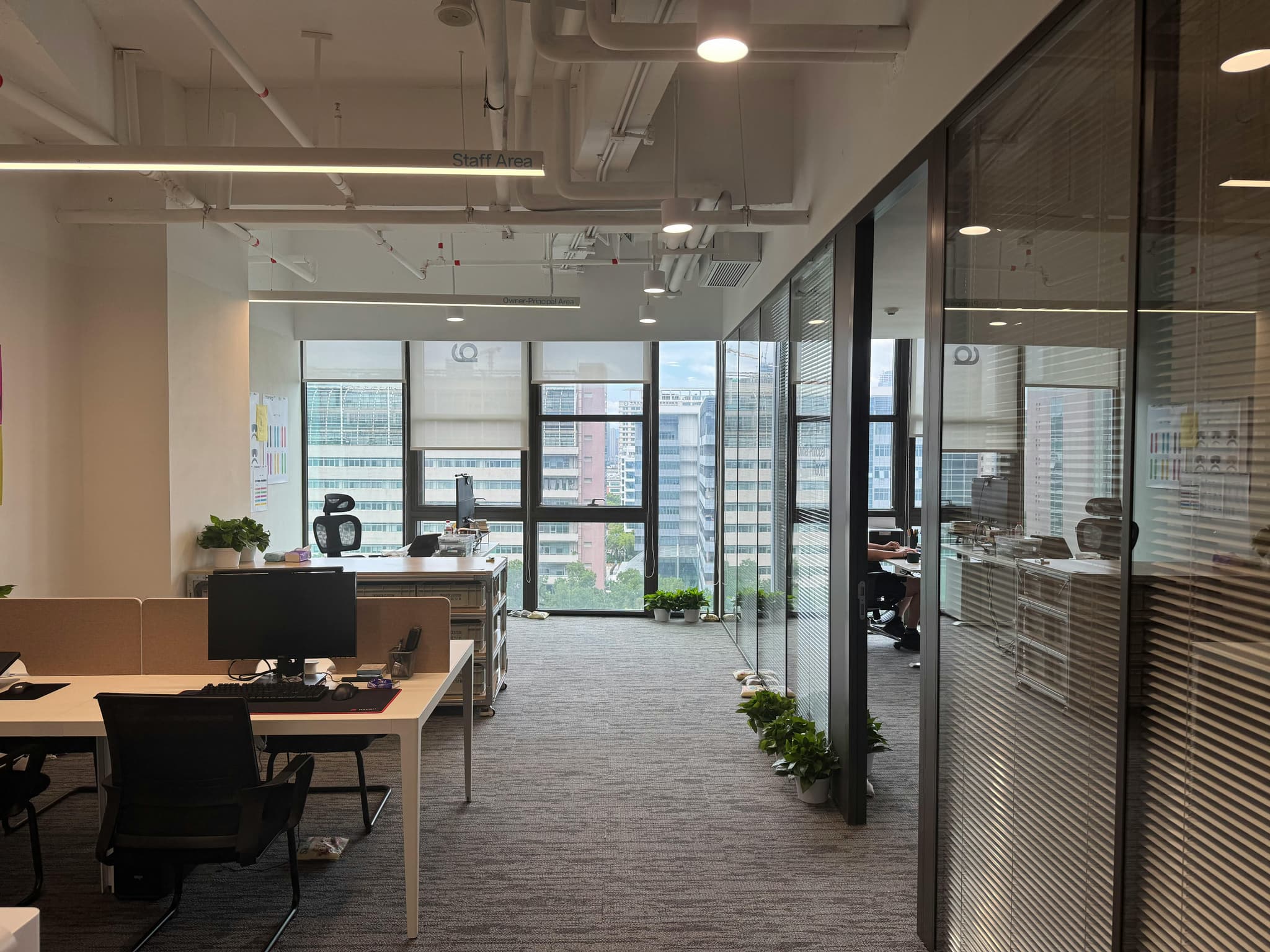
The term "private office" gets used in two very different contexts, and confusing them leads to real mistakes in workspace planning.
In a traditional real estate context, a private office means an entire commercial tenancy — a floor or suite leased directly from a landlord, fitted out at the tenant's expense, managed by the tenant. In a flexible workspace context — which is the context that matters for most businesses reading this in 2026 — a private office means something much more accessible: an enclosed, dedicated workspace within a professionally managed building, available on flexible terms, with fit-out, furnishings, and services included.
This guide covers the flexible workspace version: what a private office is, how it compares to open coworking, what it costs in Australia, and the specific circumstances where it's the right choice over alternatives.
What Is a Private Office?
A private office is a dedicated workspace used by one person, a small team, or a company. Unlike an open coworking desk, a private office gives you your own enclosed space where you can work with fewer distractions and more control over your environment.In a flexible workspace building, your private office is:
- Enclosed — four walls and a door, not a partitioned area in an open plan
- Dedicated — assigned exclusively to you or your team, not shared with other members
- Furnished — desks, chairs, and storage are typically included and ready from day one
- Serviced — cleaning, utilities, building management, and reception are handled by the operator
- Flexible in tenure — available on month-to-month or short-term agreements at most operators, with no fit-out cost or make-good obligation at exit
Private offices are the primary revenue driver across the flexible workspace industry globally — accounting for the largest share of coworking operator revenue and approximately 80% of all flexible workspace inventory. That dominance reflects a market that has settled on private, enclosed workspace as the most practical and preferred format for most professional teams.

How a Private Office Differs from Other Workspace Types
Understanding private offices is easier in contrast with the alternatives:
| Hot Desk | Dedicated Desk | Private Office | Traditional Lease | |
|---|---|---|---|---|
| Assigned space | No | Yes (desk) | Yes (room) | Yes (entire tenancy) |
| Enclosed/private | No | No | Yes | Yes |
| Leave equipment | No | Yes | Yes | Yes |
| Share with other companies | Yes | Yes | No | No |
| Fit-out cost | None | None | None | $200K–$600K+ |
| Exit process | 1–4 weeks notice | 1–2 months notice | 1–3 months notice | Make-good + legal fees |
| Price (Sydney CBD, est.) | $500–$850/mo | $700–$950/mo | $800–$1,100/desk/mo | $1,000+/m²/year + outgoings |
The private office sits between a dedicated desk (which gives you a permanent workstation but no privacy) and a traditional lease (which gives you full control but at enormous cost and commitment). For most teams of 2–15 people, it is the arrangement that best balances privacy, operational simplicity, and financial flexibility.
What's Typically Included in a Private Office
Private office inclusions vary by operator and pricing tier, but a standard private office in a well-run Australian flexible workspace building typically includes:Always included:
- Furnished office (desks, ergonomic chairs, storage)
- High-speed internet (shared or VLAN options at premium operators)
- Daily cleaning
- Building security and reception
- Access to shared kitchen and communal facilities
- 24/7 keycard or app-based access
- Heating and air conditioning (utilities)
- Building outgoings and maintenance
- Some meeting room credits per month
- Basic IT support
- Meeting room bookings beyond included credits ($30–$100/hour)
- Dedicated phone lines and receptionist services
- Parking (almost never included in CBD locations)
- Additional storage beyond the standard pedestal
- Printing beyond a basic monthly allowance
What Does a Private Office Cost in Australia in 2026?
Private office pricing varies significantly by city, building grade, team size, and operator. The national median for a private office within a flexible workspace sits at approximately $683/desk/month according to Rubberdesk Q4 2025 data — but the range is wide.Private office pricing by city (per desk, per month, indicative):
| City | Entry-level | Mid-market | Premium CBD |
|---|---|---|---|
| Sydney CBD | $800/desk | $900–$950/desk | $1,000–$1,100+/desk |
| Melbourne CBD | $700/desk | $750–$850/desk | $900+/desk |
| Brisbane | $550/desk | $600–$700/desk | $750+/desk |
| Perth CBD | $600/desk | $750–$800/desk | $900+/desk |
| Adelaide CBD | $450/desk | $500–$600/desk | $650+/desk |
| Canberra | $400/desk | $500/desk | $600+/desk |
| Inner suburbs (all cities) | $400–$600/desk | — | — |
Team size and pricing: Private office rates per desk typically decrease as team size grows. A 2-person office is priced higher per desk than a 10-person office at the same operator and building, because fixed costs (door, walls, HVAC zone) are spread across more occupants. If you're evaluating private offices for a team of 5 or more, always ask for the per-suite rate, not just the per-desk rate — the economics are often better than the per-desk figure suggests.
Who Should Use a Private Office in 2026?
Private offices are not the right choice for every business. But for specific work types and team profiles, they are clearly the correct answer. Here is where the evidence is unambiguous.1. Teams handling confidential or sensitive work
If your work involves privileged legal advice, sensitive financial data, medical records, regulated information, or commercially confidential strategy — an open-plan hot desk is genuinely inadequate, not just uncomfortable. A private office with a lockable door, a dedicated network, and controlled physical access resolves those concerns structurally.For businesses operating in legal, financial services, healthcare, or consulting — sectors where client confidentiality is a professional and often regulatory obligation — a private office is not a luxury. It's a baseline requirement.
2. Teams of 3 or more with regular in-office presence
For a solo operator who comes in twice a week, a hot desk typically makes more sense economically. But for teams of 3 or more who are in the office regularly, the private office almost always delivers more value per dollar:- The daily setup/pack-up ritual of hot desking multiplies across everyone on the team
- Equipment can be permanently set up (monitors, docking stations, shared hardware)
- The team can sit together reliably, rather than occupying whatever desks happen to be available that day
- 24/7 access is typically included, removing business-hours limitations
3. Client-facing businesses
If clients visit your workspace — for meetings, consultations, or presentations — the environment they walk into is part of your professional presentation. A private office in a well-run flexible workspace building provides a reception desk, a professional waiting area, and your own enclosed space to host clients without ambient noise or shared-desk chaos.A coworking hot desk cannot replicate this. The right workspace should support your work style. It should not force you to adjust your business around constant interruptions — and it certainly should not require you to book a meeting room every time a client comes in.
4. Businesses that need team identity and culture
A private office creates a psychological and physical space that belongs to your team. You can put your brand on the door, leave your team's work visible, and create an environment where employees feel they are arriving at your company's space rather than a shared facility.This matters more than it might seem. Hybrid work has already dissolved many of the cultural anchors that kept teams cohesive. The private office — even a small one — provides a territorial base that helps preserve team identity in a way that a hot desk membership categorically cannot.
5. Businesses establishing a new-market presence
For businesses setting up an interstate satellite office or entering a new city for the first time, a private office within a flexible workspace building is often the optimal choice. It provides the substance of a real office — dedicated space, professional address, meeting room access — without the capital commitment of a full lease or the setup overhead of an independent tenancy. As covered in our guide to setting up an interstate satellite office, a private suite is typically the right second step after validating a new market with an initial hot desk or dedicated desk arrangement.
When a Private Office Is Not the Right Choice
Intellectual honesty requires naming the cases where a private office is the wrong answer.You're a solo operator using the space 2 days a week or less. At low frequency, the per-visit cost of a private office is difficult to justify. A hot desk membership or day pass arrangement almost always costs less and offers adequate functionality.
Your team is fully remote and you only need occasional meeting space. A virtual office plan with meeting room credits, or a hot desk membership with bookable meeting rooms, is more economical than a private office for a team that never needs a daily desk.
You're a freelancer or sole trader whose work is purely laptop-based and call-light. The acoustic privacy advantage of a private office is real — but if you rarely take calls and work effectively in a communal environment, paying the premium for enclosure isn't justified.
You prioritise community and serendipitous connection above all else. This is coworking's genuine competitive advantage. A team that disappears into a private office suite and never engages with the broader coworking community foregoes the networking and cross-pollination value that makes flexible workspace compelling for early-stage businesses.
Private Offices in Sydney: A Strong Market in 2026
Sydney has the deepest and most mature private office market in Australia. With over 70 flexible workspace locations across the CBD, Barangaroo, North Sydney, and the inner suburbs — and a wide range of operators from premium (Work Club, Hub Australia, WeWork) to mid-market (Christie Spaces, WOTSO) — businesses evaluating a private office in Sydney have genuine choice at every price point.Corporate and professional coworking holds the largest share of the global flexible workspace market, driven by demand for private, secure, and well-equipped environments. Sydney's private office market exemplifies this: the majority of flexible space rented in Sydney's CBD is now private offices rather than open coworking desks, reflecting how decisively the market has moved toward enclosed, dedicated space.
→ Browse private offices in Sydney
Ready to Find a Private Office?
OfficeFlexFinder lists private offices across every major city and suburb in Australia — with verified pricing, transparent inclusions, and real photos. Compare options side by side before booking a tour.Browse private offices in Sydney, or explore private offices in:
You can also explore:- Private office vs open coworking: which boosts productivity?
- Serviced office vs coworking: which is right for your team?
- How much does coworking cost in Australia in 2026?
- How many desks does your team actually need?
About OfficeFlexFinder: We help Australian businesses, freelancers, and remote workers find and compare flexible office space — from hot desks to private offices and serviced suites — across every major city and region in Australia.
Arthur Truong
Content Editor
Office space specialist helping businesses find their perfect workspace.
